Denise Regan and I are launching this print exchange folio to celebrate Print Day in May 2026! If you would like to create a 10x10cm handmade and editioned print of a flabby feline, dastardly dog or a related pesky pet, you are very welcome to join in the fun. Essential details:
Edition size – 10 prints (1/10 to 10/10)
Image size – 10 x 10 cm
Paper size – 14 x 14cm (archival paper please)
Please post your set of prints (interleaved with acid-free tissue or glassine paper) to:
Definition: “Collagraphy (sometimes spelled collography) is a printmaking process introduced in 1955 by Glen Alps in which materials are applied to a rigid substrate (such as paperboard or wood). The word is derived from the Greek word koll or kolla, meaning glue, and graph, meaning the activity of drawing.”
Usually, a sheet of matt board (rigid cardboard) is used as the base and a variety of textured materials are applied with glue. When the plate is completely dry, it is coated with two coats (minimum) of shellac, to seal the plate and make it waterproof. Then ink is applied in the same way as an etching plate – ink is applied with a spatula or piece of card, spread and pushed into the grooves and recesses with a tarlatan cloth and then polished with fine paper (a page of telephone book is great).
Damp paper is placed over the inked plate and then rolled through a printing press to transfer the image to the paper. The key concept is that rough materials (carborundum, scrunched tissue paper, sandpaper) collect the ink and create a dark tone, while smooth and shiny materials (PVA, foil) allow the ink to be polished off easily and therefor create lighter tones.
Over four consecutive weeks, I will be running Beginner’s Collagraph workshops at Port Fairy Community House on Saturday mornings between 10am and 12noon. Contact PFCH for bookings.
I am also offering Gelatin Plate Monoprinting and Linocut Workshops at “Off the Rails” in Dunkeld. Gelli-printing will be from 1.00 to 3.00pm on Saturday 26th August ($50) and Lino-printing will be from 10.00am to 3.00pm on Saturday 2nd September ($80 – bring your own lunch or purchase in Dunkeld). Bring your own aprons and ideas! Contact me at brittgow(at)gmail.com for bookings.
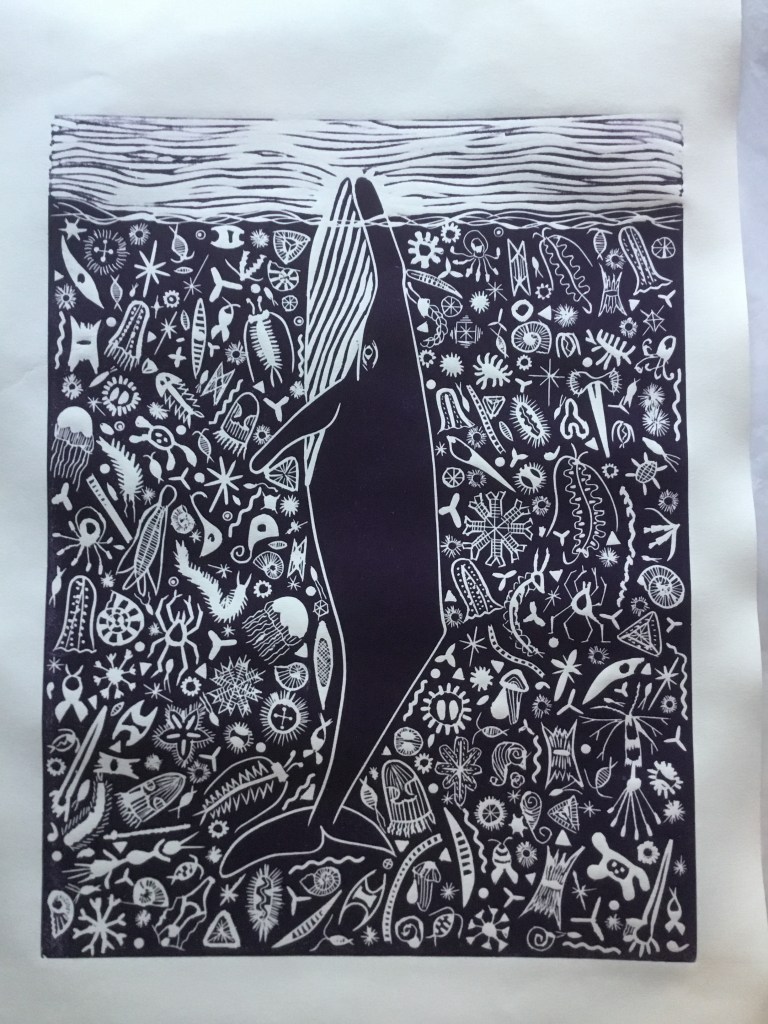
I created the design for this linocut plate in 2018 when I was completing my Diploma of Visual Arts at SW TAFE in Warrnambool. It has been one of my most popular prints, with an edition of 20 in light blue (called ‘Upwelling’) and a second edition of 20 in dark midnight blue, called ‘Upwelling at Night’. I have recently recovered the plate from my map drawers and reprinted in a deep, dark purple, called ‘Indigo Upwelling’. The paper I selected is Arnhem 1618, 100% archival cotton rag paper in warm white, with Caligo Safe Wash ink. Due to differences between screens/ monitors and camera quality, it is difficult to see the colour accurately. However, if you go to the Senior’s Art site you can see a colour sample for Carbozole Violet, which is the ink I used. https://seniorart.com.au/index.php?main_page=index&cPath=2478_2480_2703
If you are interested in purchasing this new print, the price is $150, including packing in a cardboard tube and postage.
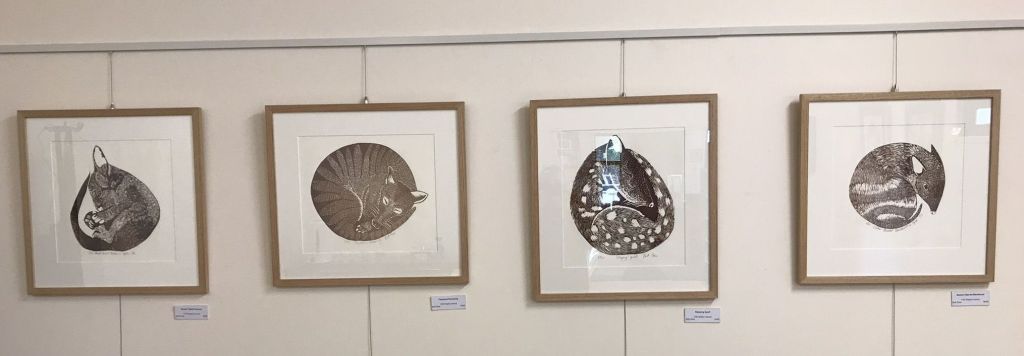
These four original, hand-pulled linocut prints are on display and for sale at the Lake Bolac Community and Business Centre over the next few months. There are a total of ten framed, limited edition artworks available. I am also planning to provide a Gelatin Plate Monoprinting workshop at this venue, prior to the end of the year.
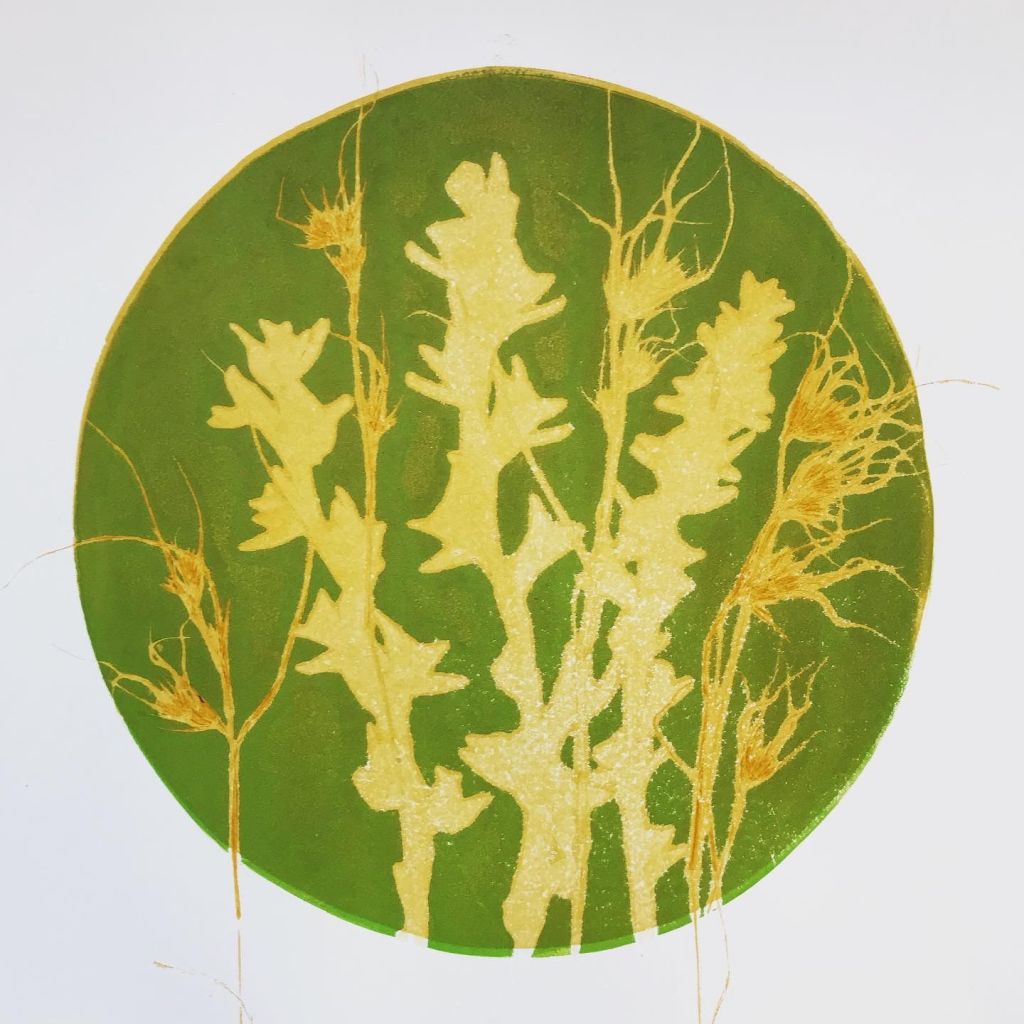
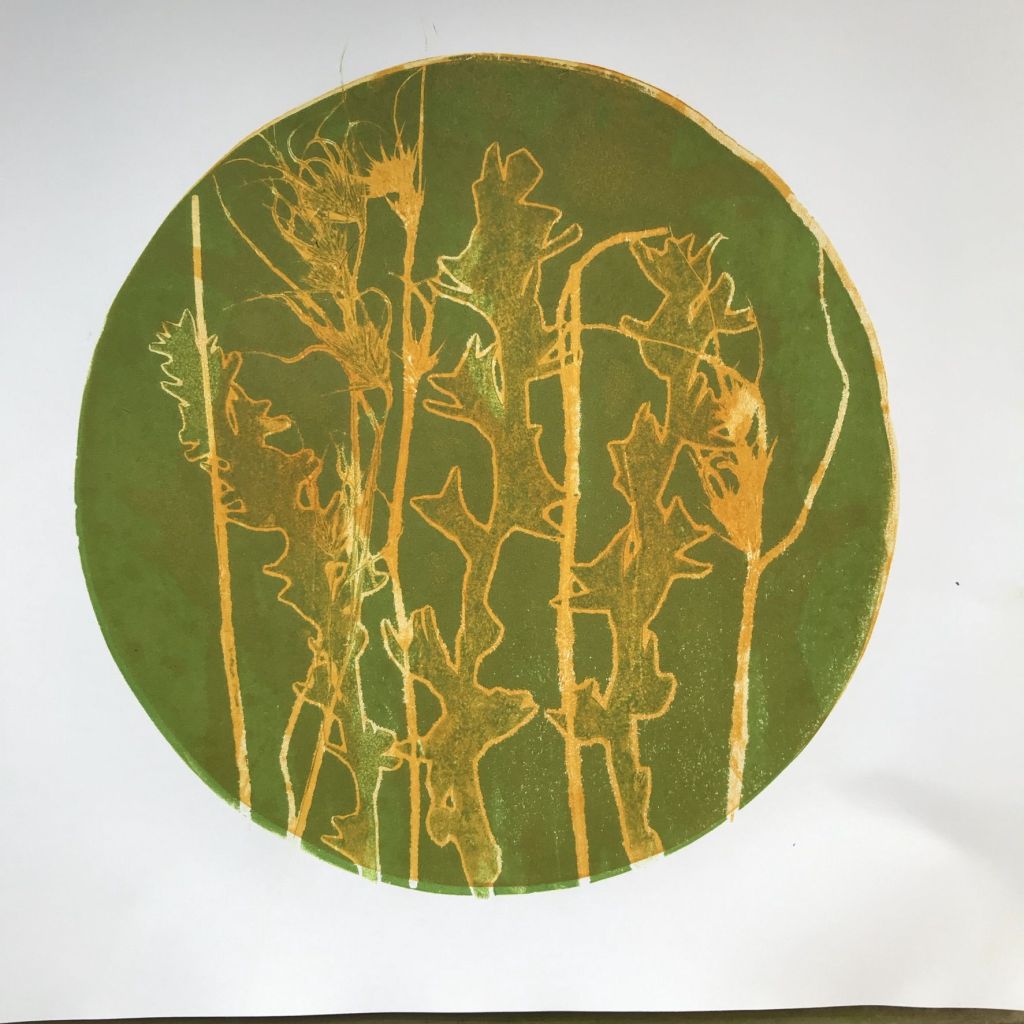
Monoprinting is a spontaneous and somewhat unpredictable process that can be easily achieved at home, without specialized equipment. The gelatin plate is a soft and malleable surface that can hold the detailed impressions that you make on it with brushes, botanical materials, stencils, masks and stamps. In my gelatin plate monoprinting workshops you will learn how to make your own gelatin plate and use it to create unique, layered artworks that can be enjoyed alone or used as backgrounds for multimedia, card creation or cut into collages.
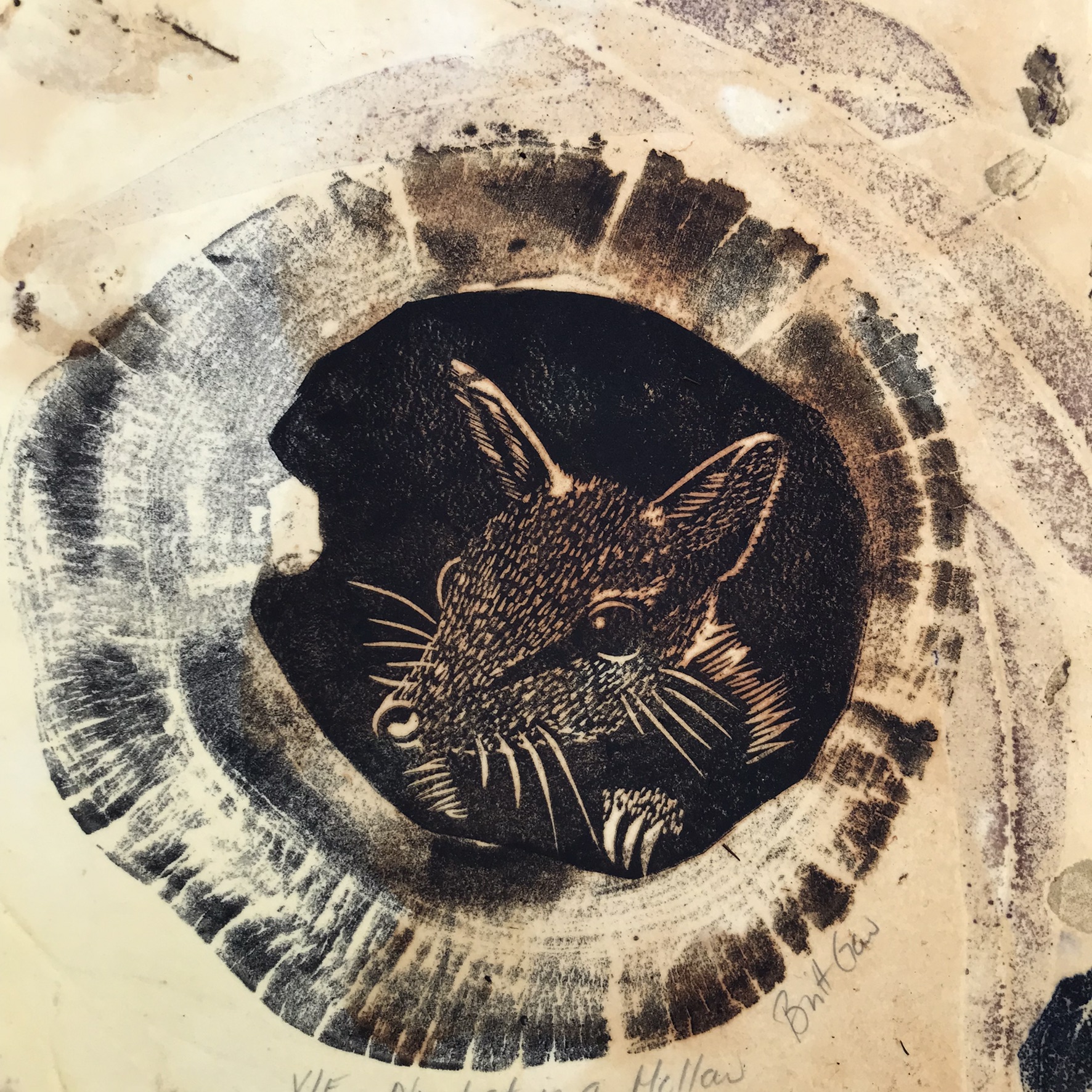
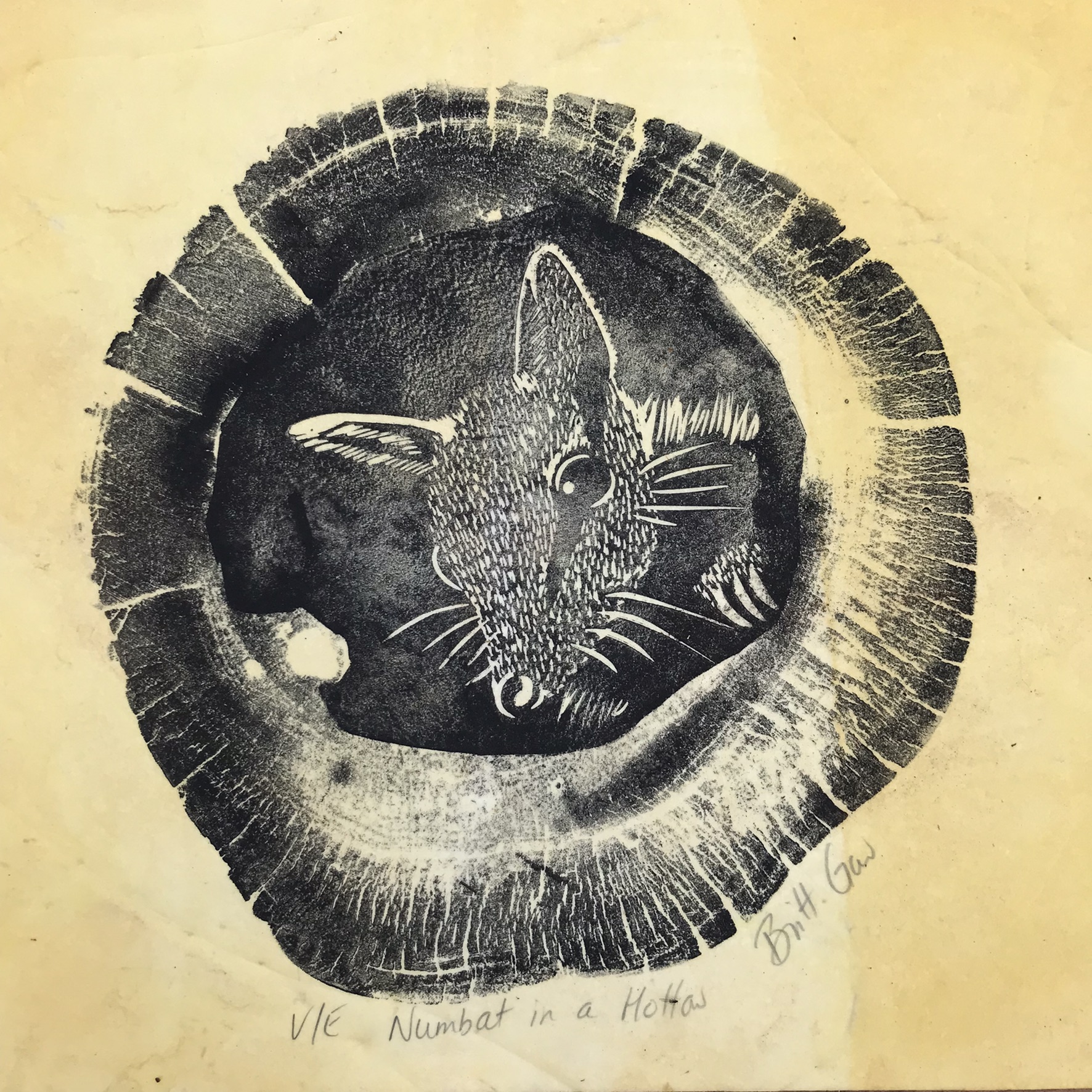
These creatures in hollows are the result of several printmaking processes – woodgrain prints, linocut, heat-press botanical prints and brown onion skin dip-dyeing. Creating a wood grain print requires lots of sanding, charring with a blow torch and then cleaning the wood slice with a wire brush. I have used three different linocuts – numbat, Krefft’s glider and Sooty owl. Finally, arranging eucalyptus leaves on the paper, sandwiched between wet wool blankets and ‘cooked’ in the heat press for about two minutes to transfer the images to the paper. The orange colour is obtained from a woolen blanket soaked in iron solution and the yellow from a brown onion skin ‘soup’. The aim is to achieve a variety of natural colours and textures to complement images of our native fauna.
On Sunday 3rd July, 12 participants came along to my Beginner’s Linocut Workshop at the Merri View Gallery, hosted by Warrnambool and District Artist’s Society. We had a busy day (9.00am to 3.00pm) learning about the tools and materials, the design process, carving the linoleum block and printing on paper. I was pleased that everyone had the opportunity to carve at least one small block and produce one or more printed cards.
As there were people unable to attend on that date and several on the waiting list, WADAS are pleased to host another workshop on Sunday 18th September. Jenny Adams is taking bookings, but we are limiting it to ten places this time, to give us a bit more elbow room! All linocut tools and equipment supplied, except bring your own apron, lunch and drawing materials.
I never imagined I would be invited to exhibit my artwork in a gallery, but when MOCO gallery in Halls Gap suggested I should book an exhibition a year ahead, I thought ”Maybe I’ll be ready then”. My work with wood grain and linocut prints has developed over this time and I am pleased to be able have them on show. Hall’s Gap, in the Grampians, is the ideal location for this exhibition, as the bush environment has many examples of fallen limbs and trees, stumps and hollows in the trunks of living and dead trees. These hollows are vital habitats for many bats, birds, possums, gliders and other marsupials. Hollows take many years to form, starting when limbs fall and organisms start to break down the wood, creating a cavity in the limb or trunk. Large hollows, such as those needed by black cockatoos for nesting, can only form in trees that are over two hundred years old. Due to land clearing and habitat destruction, there are very few of these old trees left, so there is much competition for hollows.
My woodgrain prints are created by firstly selecting a suitable piece of salvaged timber, perhaps firewood or a slice cut from a fallen tree. A thin slice is then sanded flat and burnt with a blow torch to raise the wood grain. For each print, the relief ink is rolled onto the wood, damp paper is placed over the inked wood and then the back of the paper is pressed with a glass baren, to transfer the ink from the wood to the paper. For my ”One Forest” series, I use an ink pen to draw tiny little trees all around the perimeter of the wood grain print. For the ”Hollows” series, I print over the woodgrain with a linocut print.
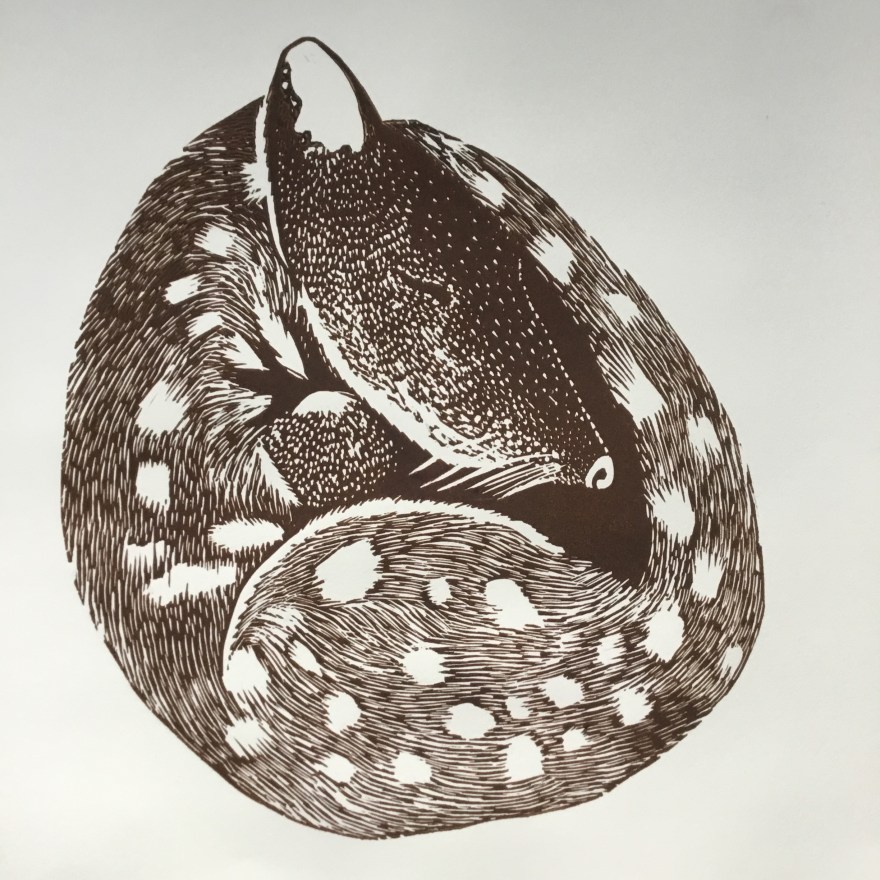
Sleeping Quoll – Linocut, sepia ink on 100% cotton paper (56 x 56cm)
After three markets at Port Fairy in Nov/Dec and several artworks delivered to various galleries, I am pleased to be able to start drawing and carving some new linocuts for the new year. I am continuing to explore woodgrain prints and native fauna that shelter in tree hollows. Best wishes for a very happy festive season and a wonderful 2022. Come and say hello at the New Year’s Day Community House Market in Port Fairy.
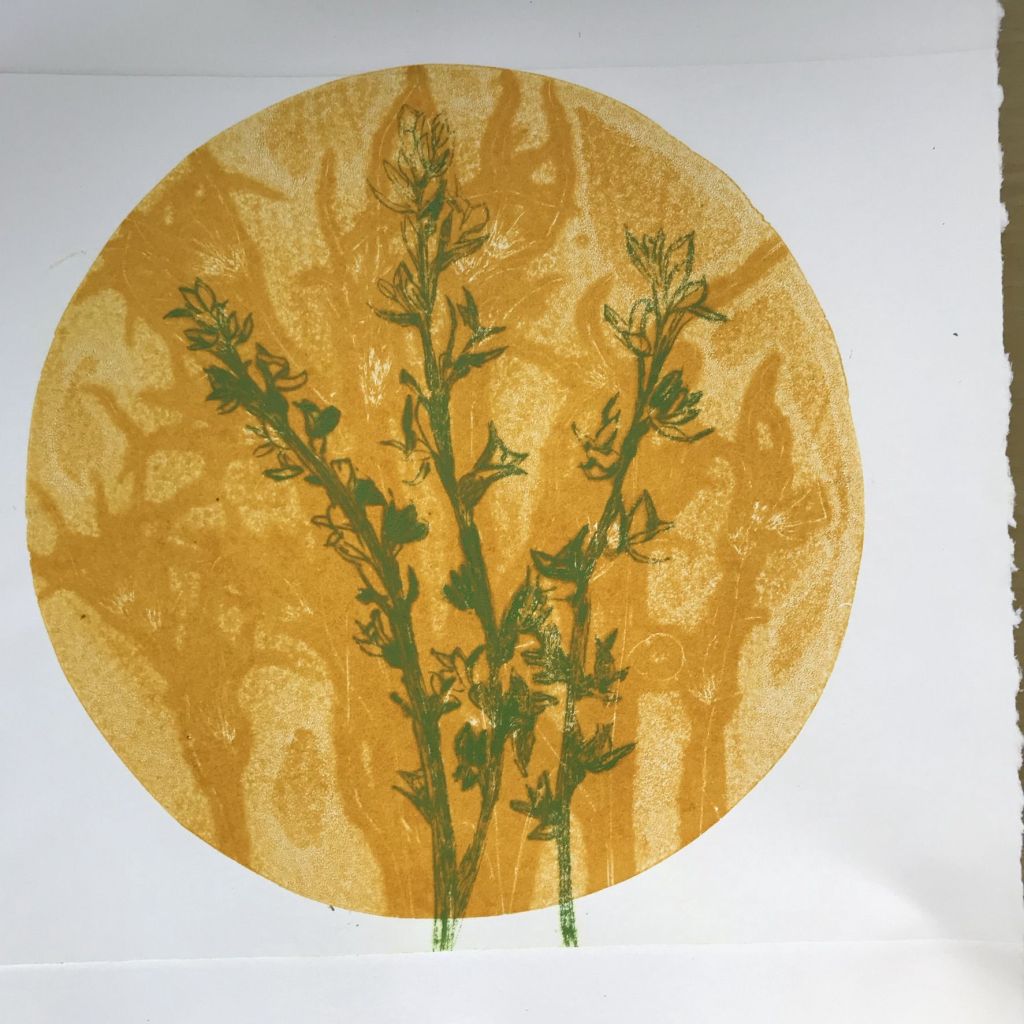
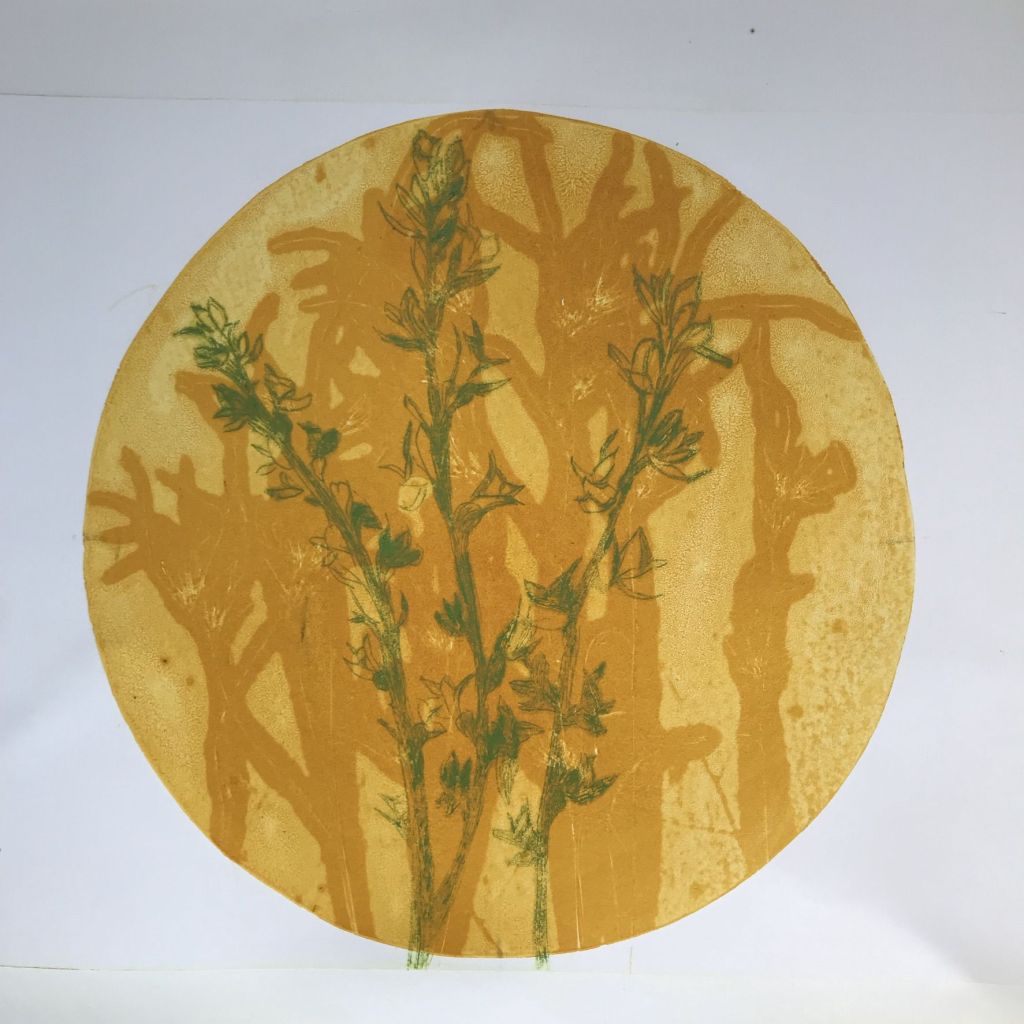
These are nine different images of etchings printed over monotypes or watercolour-enhanced etchings (#1 and #2). The Basalt Leek Orchid is a rare and endangered plant species found in damp and undisturbed pockets of the western volcanic plains. It is a small and well-hidden species, often overlooked due to it’s short flowering period.










 Britt Gow